What Are the Top RF Coaxial Connector Types in 2026?
Choosing the right Rf Coaxial Connector in 2026 requires more than comparing thread sizes or catalogue prices. Engineers now evaluate frequency range, return loss, insertion loss, power handling, shielding, durability, and installation quality. A connector may look perfect on a bench, yet perform poorly after repeated mating cycles or cable movement. Small details matter.
Microwave engineering author David M. Pozar has emphasized that “interconnections can limit the performance of a microwave system.” That warning remains highly relevant. The connector is part of the RF path. It is not a simple accessory.
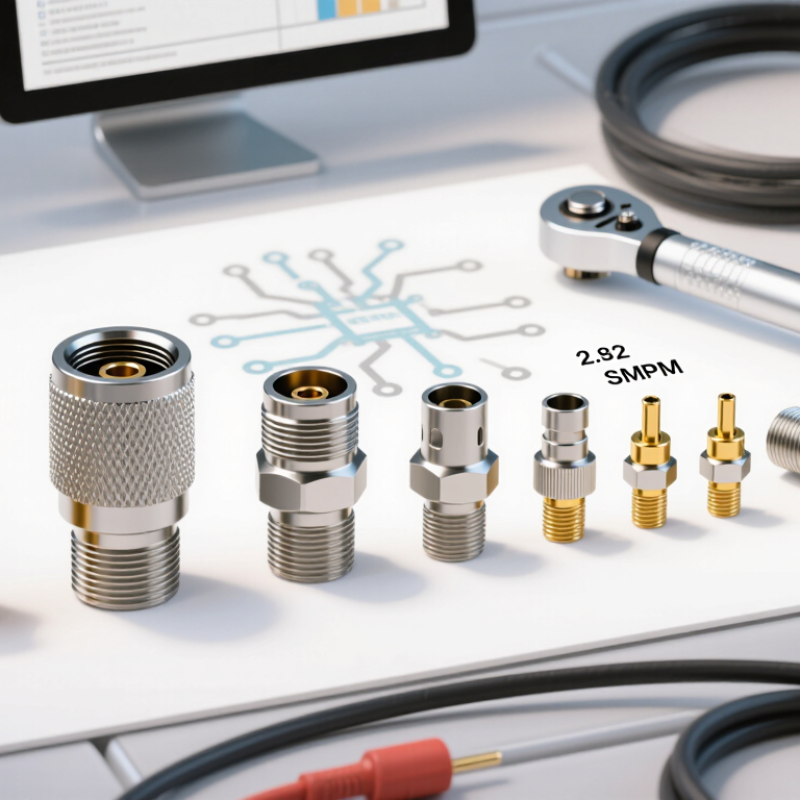
This guide examines the leading connector types shaping modern RF designs. SMA connectors remain common in compact equipment and test fixtures. Type N connectors still serve outdoor and higher-power applications. BNC and TNC models offer practical choices for instrumentation and mobile systems. Precision 2.92 mm, 2.4 mm, and 1.85 mm connectors support demanding millimeter-wave measurements. SMP and SMPM connectors help reduce size inside dense assemblies.
The best choice depends on the whole system. Cable quality, torque control, plating, sealing, and calibration can change results. A cheaper option may become expensive after failure.
There is no universal winner.
Some classifications also overlap. Frequency ratings differ between manufacturers, and published specifications may depend on ideal conditions. That is why this article compares real-world performance, not labels alone. It considers where each Rf Coaxial Connector works well, where it struggles, and which design assumptions deserve another look.
RF Coaxial Connectors: Structure, Purpose, and Operating Principles
What Are the Top RF Coaxial Connector Types in 2026?
RF coaxial connectors guide high-frequency signals between cables, antennas, filters, and test equipment. Their structure is simple but precise: a center conductor carries the signal, while a dielectric supports it. A surrounding metal shell provides shielding and completes the return path. That geometry controls impedance, reflection, and electromagnetic leakage.
Most systems use 50-ohm connectors for wireless infrastructure and measurement equipment. Television networks commonly use 75-ohm designs. SMA connectors suit compact microwave assemblies, while N-type connectors offer stronger outdoor protection. BNC remains practical for quick laboratory connections. TNC adds a threaded interface for improved vibration resistance. Higher-frequency systems often select 2.92 mm or 2.4 mm connectors. Small details matter. A damaged contact can increase VSWR and insertion loss.
MarketsandMarkets’ 2024 RF coaxial cable analysis projects the market to grow at about 7% annually through 2029, driven by wireless networks, testing, and aerospace electronics. The report reflects rising demand for reliable high-frequency interconnects. Grand View Research also identifies telecommunications and data infrastructure as major connector-market applications. Yet market categories can mislead. A connector rated for high frequency may still fail outdoors if its seal, torque, or cable termination is poor. In field inspections, installers often focus on the connector body and overlook the mating surface. That is a costly weakness. Careful impedance matching, correct torque, clean interfaces, and verified cable preparation remain essential to stable RF performance.
Key Criteria for Ranking RF Connector Types in 2026
What Are the Top RF Coaxial Connector Types in 2026?
Ranking RF coaxial connectors in 2026 requires more than comparing frequency ratings. A practical evaluation starts with application demands, measurement evidence, and lifecycle cost. Grand View Research forecasts the global RF connector market to grow at roughly 7% annually through 2030. That expansion reflects higher-density wireless systems, test platforms, and satellite equipment.
Frequency range remains a primary filter. Connectors supporting millimeter-wave operation deserve higher scores for advanced laboratory and radar applications. However, bandwidth alone can mislead. Return loss, VSWR, insertion loss, and phase stability often separate reliable designs from merely impressive specifications. A low VSWR reduces reflected energy. It also improves measurement confidence.
Mechanical and environmental performance should carry equal weight. Evaluate mating cycles, contact retention, vibration resistance, temperature range, and sealing quality. For outdoor equipment, an IP-rated interface can matter more than a higher laboratory frequency. MarketsandMarkets reports continued growth in RF test equipment, driven by 5G, aerospace, and semiconductor testing. That trend increases demand for repeatable connections, not just compact ones.
A sensible ranking should also consider impedance consistency, cable compatibility, field replacement, and calibration effort. Standard 50-ohm systems remain dominant. Still, real installations often expose weaknesses hidden in datasheets. A connector may pass a factory test yet degrade after repeated handling. This is where experience matters. No ranking stays perfect. Engineers should validate shortlisted types with torque checks, thermal cycling, and network-analyzer measurements before deployment.
What Are the Top RF Coaxial Connector Types in 2026?
Ranking is based on the commonly specified upper operating frequency of each connector interface. Frequency capability is only one selection criterion; power handling, insertion loss, mechanical durability, environmental sealing, size, and cost should also be evaluated.
High-frequency performance 2.92 mm, 2.4 mm, and 1.85 mm interfaces are preferred for millimeter-wave test, measurement, and high-frequency instrumentation.
Power and ruggedness N-type and 7/16 DIN interfaces are widely selected when outdoor sealing, mechanical strength, and higher power handling matter more than compact size.
Compact connectivity SMP provides a small form factor for dense assemblies, while SMA remains a common general-purpose choice for microwave systems up to 18 GHz.
Values represent commonly specified interface limits from established connector standards and technical specifications; the actual usable frequency depends on the connector variant, cable assembly, PCB launch, mating condition, and measurement setup.
SMA, N, TNC, and BNC Connectors for General RF Systems
What Are the Top RF Coaxial Connector Types in 2026?
RF coaxial connector selection is becoming more important as wireless systems operate across wider frequency ranges. Grand View Research estimates the global RF connector market at roughly USD 3.3 billion in 2023, with a projected 6.8% CAGR through 2030. That growth reflects demand from telecommunications, test equipment, sensing, and industrial electronics. However, market growth does not make every connector suitable for every installation.
SMA connectors remain practical for compact RF modules, laboratory cables, and equipment operating into the microwave range. Their threaded coupling offers good mechanical stability, but small threads require careful torque control. N connectors provide stronger weather resistance and higher power handling, making them useful for outdoor antennas and base-station systems. Typical designs support frequencies around 11 GHz, although performance varies by construction. TNC connectors add threaded security to the familiar BNC-style format. They suit mobile equipment where vibration could loosen a bayonet connection.
BNC connectors still serve test benches, video systems, and legacy instruments because their bayonet coupling is quick and easy. Small, but capable. Their frequency ceiling is often near 4 GHz. The IEC 61169 series supports consistent connector definitions, yet published limits still differ between cable assemblies. A common mistake is selecting by connector name alone. I would recheck impedance, return loss, insertion loss, sealing, and mating cycles before approving a design. Torque matters. So does the cable. (MarketsandMarkets, RF Connectors Market report, 2024)
What Are the Top RF Coaxial Connector Types in 2026? - SMA, N, TNC, and BNC Connectors for General RF Systems
| Connector Type | Typical Impedance | Typical Operating Frequency | Coupling Method | Environmental Characteristics | Common RF Applications | Key Advantages | Main Limitations |
| SMA | 50 Ω | Commonly DC to 18 GHz; precision variants may support higher frequencies | Threaded screw coupling | Good mechanical retention; weather resistance depends on the specific design and sealing | Test equipment, antennas, wireless modules, microwave assemblies, and compact RF cables | Small size, reliable connection, and strong high-frequency performance | Requires multiple turns to mate; smaller form factor can be less convenient for frequent connection cycles |
| N | 50 Ω or 75 Ω | Commonly DC to 11 GHz; exact performance depends on the interface and cable assembly | Threaded screw coupling | Robust construction and good environmental sealing when properly installed | Base-station antennas, wireless infrastructure, outdoor RF links, and high-power coaxial systems | Durable, mechanically stable, and suitable for comparatively higher RF power levels | Larger and heavier than SMA, TNC, and BNC; slower to connect and disconnect |
| TNC | 50 Ω | Commonly DC to 11 GHz; some precision versions support higher frequencies | Threaded screw coupling | Better vibration resistance than bayonet-style coupling; sealed versions are available for outdoor use | Mobile radios, vehicle antennas, navigation equipment, and vibration-prone RF installations | Threaded retention with a form factor similar to BNC; dependable in mobile environments | Less convenient for rapid changes than BNC and generally larger than SMA |
| BNC | 50 Ω or 75 Ω | Commonly DC to 4 GHz; many general-purpose versions are used at lower frequencies | Bayonet twist-lock coupling | Convenient for indoor and laboratory use; outdoor performance requires suitable sealing and strain relief | Oscilloscopes, signal generators, measurement instruments, video systems, and laboratory interconnects | Fast mating, broad availability, and easy visual identification | Lower typical frequency capability than SMA, N, and TNC; bayonet locking may be less resistant to severe vibration |
Selection note: Frequency ratings are typical industry ranges rather than universal limits. Actual performance depends on connector gender, interface design, cable type, assembly quality, impedance, voltage standing-wave ratio, and environmental requirements. Always verify the applicable specification for the complete connector and cable assembly.
SMP, MCX, MMCX, and U.FL Connectors for Compact Designs
What Are the Top RF Coaxial Connector Types in 2026?
Compact wireless devices need connectors that save space without sacrificing signal stability. SMP connectors suit high-frequency systems and blind-mate assemblies where repeated alignment is difficult. MCX connectors offer a practical snap-on interface for moderate-density equipment. MMCX connectors are smaller, making them useful near crowded circuit-board edges. U.FL connectors occupy very little board space and support short cable links inside sensors, routers, and tracking devices.
Each type has trade-offs. SMP usually handles demanding RF layouts, but its stronger mechanical design may increase cost and assembly effort. MCX and MMCX are easier to connect by hand, although repeated movement can stress their snap mechanisms. U.FL is extremely compact, yet its small cable and delicate mating structure need careful routing. In bench testing, I would verify return loss, insertion loss, and cable strain rather than trust size alone. That assumption can fail.
Tips: Confirm 50-ohm impedance, operating frequency, mating cycles, and clearance before layout approval. Keep RF traces short and controlled. Avoid sharp cable bends near U.FL and MMCX joints. Check the datasheet twice. A connector that fits mechanically may still perform poorly electrically. Selection also depends on assembly tools, vibration exposure, and service access. Even experienced designers can overlook the operator’s hand space.